Boot lifecycle
Deployment stages a candidate but never commits it. The boot is where the switch actually happens, and where the system decides whether the new image is allowed to stay. If it is not, the boot chain returns to the last good image on its own.
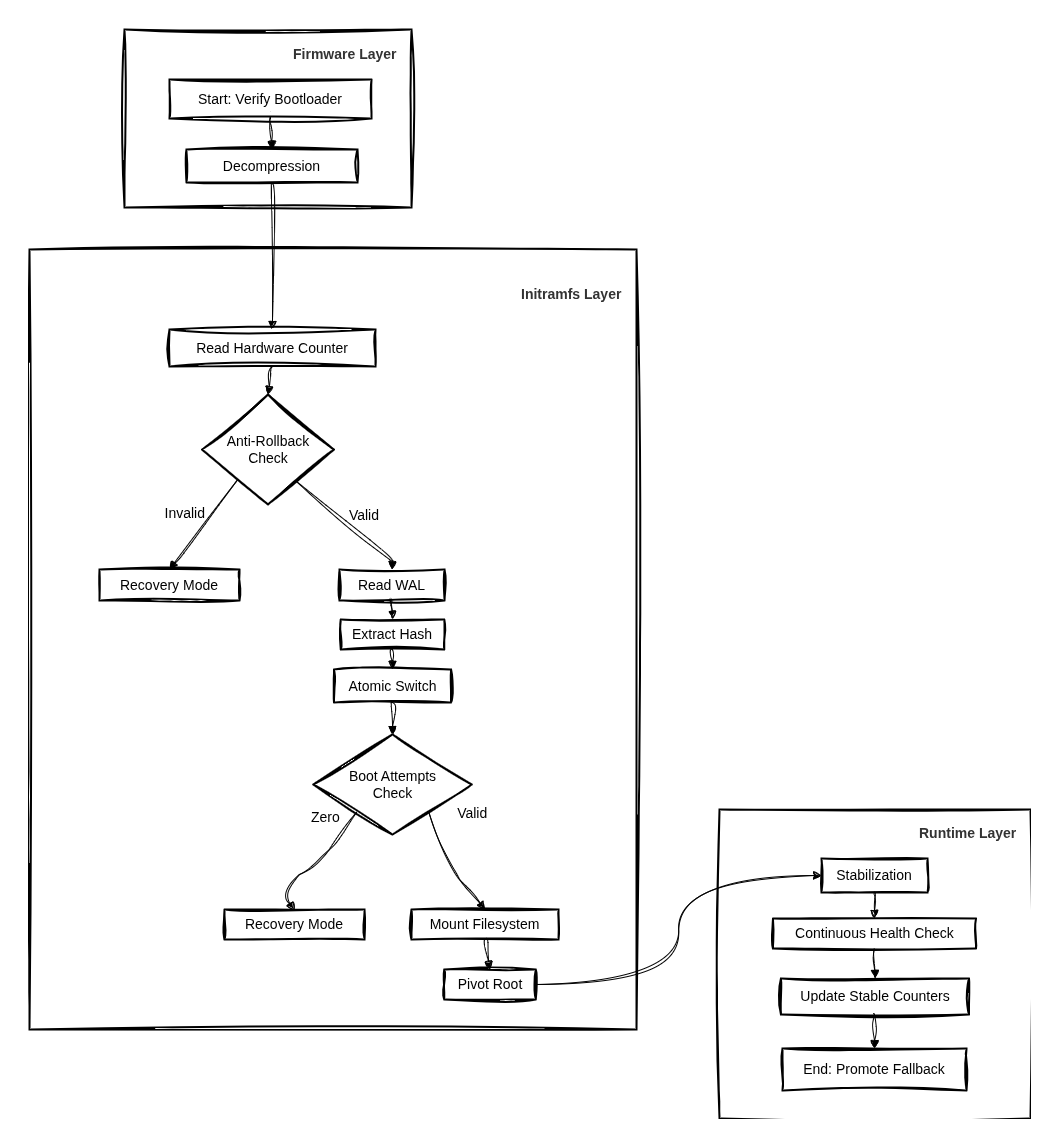
The layers
Booting an Atom Loops system passes through a chain of checks, each narrower than the last:
- Firmware verifies the bootloader. UEFI Secure Boot validates the loader before it runs.
- The loader selects a slot and verifies it. The Zig UEFI loader picks the boot slot and checks the signature before chainloading the kernelcache. It will not hand control to an image it cannot verify.
- The initramfs decides whether to switch. The early-boot engine reads the
anti-rollback counter and the write-ahead log, sets up dm-verity for the target
root, and performs the atomic slot switch before
switch_root. A tampered or unverifiable root never boots. - The runtime stabilizes and promotes. After enough good boots, the daemon promotes the candidate to the confirmed image and the previous one becomes the fallback.
Attempt counter and fallback
The boot is bounded by an attempt counter. Each try at a fresh candidate consumes an attempt. If the candidate fails to come up and the counter runs out, the boot chain falls back to the last good image, or drops into recovery if there is no good image to return to. This is what makes a bad update self-healing: no human has to intervene to get a working system back.
dm-verity
The target root is set up under dm-verity before switch_root, so the running
system's integrity is enforced by the kernel block layer, not just checked once at
boot. A modification to the on-disk root surfaces as a verity error rather than
silently running.
See Anti-rollback for how downgrade attacks are blocked, and The deployment WAL for the state the initramfs reads.