Deployment lifecycle
The deployment side runs while the system is up. A background daemon prepares the next update and stages it, but never switches anything on its own. The switch is a boot-time decision, covered in Boot lifecycle.
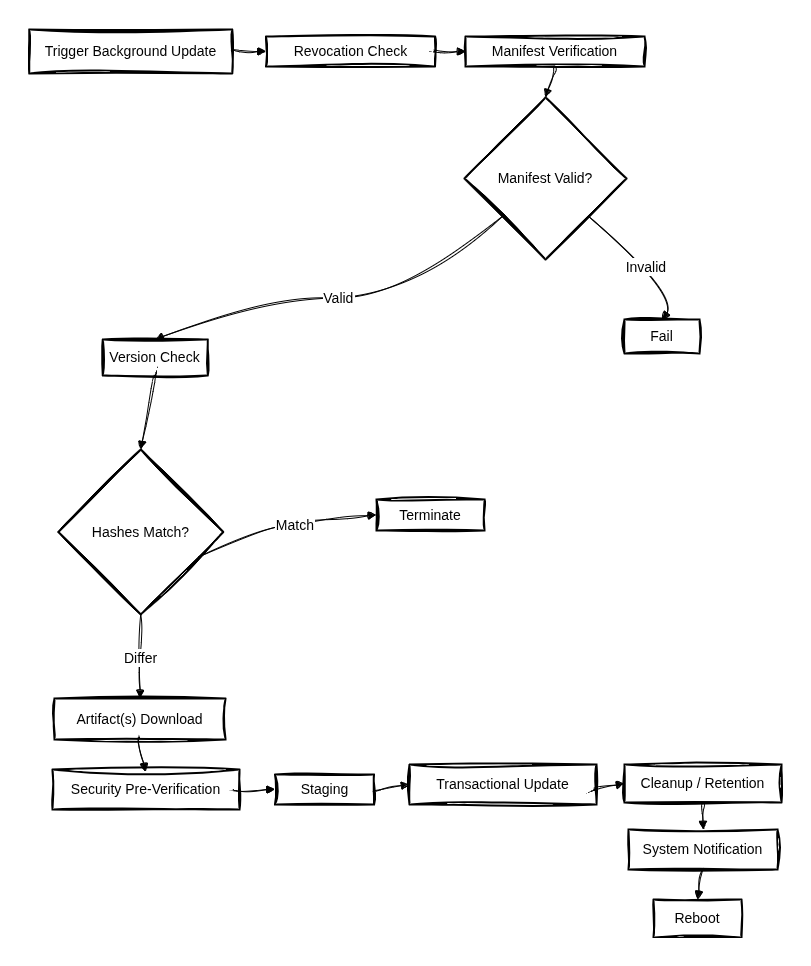
The stages
The daemon walks an update through a fixed sequence. Each stage can abort the update cleanly, leaving the running system untouched.
- Revocation check. Before anything else, the daemon checks the revocation list signed by the root key. A revoked signing certificate stops the update here.
- Manifest verification. The signed manifest describes the update: versions, artifacts and their hashes. It is checked against the signing certificate, which is itself checked against the root key.
- Version and hash comparison. The daemon compares the manifest against the current deployment state to decide what actually needs to change.
- Download. Only the changed artifacts are fetched. The transport is untrusted: an artifact served over any host or link is still authenticated by its signature and hash.
- Pre-verification. Downloaded artifacts are re-verified by hash against the manifest before they are allowed near the staging slot.
- Staging. The verified image is written into the inactive slot and its verity hash is recorded. Boot confirmation checks that hash and the release version carried by the signed UKI command line. Nothing is switched yet.
Nothing is switched until boot
At the end of a successful deployment the new image sits staged in the inactive slot, recorded in the write-ahead log as a candidate. The running system is unchanged. The decision to actually run the candidate belongs to the next boot, which is where anti-rollback and the atomic switch happen. This split is what makes a failed update a non-event: if staging is interrupted, the boot simply never sees a candidate.
See The deployment WAL for how this state is recorded crash-durably, and Trust model for the verification chain.